Grok Bot now sends my morning greenhouse briefing
In a strawberry greenhouse, the morning weather sets the plan for the day. Is the wind strong? Will it get cold? Will it rain? I now have Grok Bot tell me.
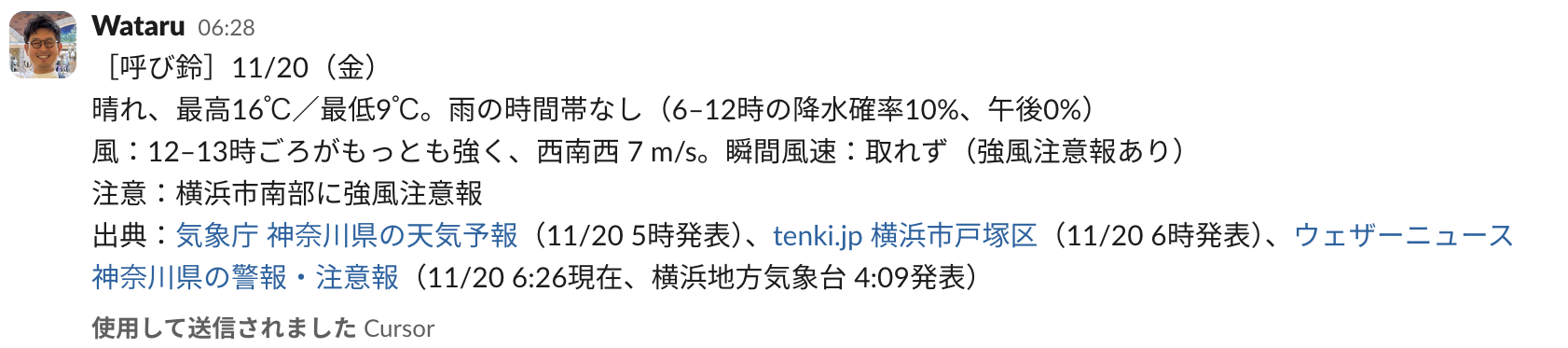
I started on November 19. The next morning, the 20th, it ran at its set time for the first time (6:28). It is still new and I have no numbers on the effect. This is a record of the setup, the rules, and what went wrong in the first few days.
What I thought about before starting
When handing a morning briefing to an AI, my question was how far to let it go. Looking up the weather and telling me is simple. If one AI also made the decisions and operated the greenhouse, it would be hard to trace what happened when it got something wrong.
So I built it in this order: keep the job small, split the roles, and decide first what it must not do.
Only two things are automated
The first is the “morning bell” at 6:30. It reports the local weather, temperature, rain, peak gusts and weather advisories, each with who issued it (the source) and the time of issue. I require the source and the time so that I never decide on old information, or on information from nowhere.
When gusts reach 10 m/s or more, or the low falls to 5°C or 2°C or below, it adds a warning. These numbers are provisional. I will align them with the values the greenhouse controls use. The controls are described in One brain for the greenhouse.
The second is a round of X at 7:00. It collects posts about local farms, cafés and strawberry sweets, tags them, and sums each up in three lines or fewer.

The split: Grok Bot only gathers, Claude Code decides
The split of roles took the most thought. Grok Bot's job ends at gathering outside information and writing it to a private Slack channel. Decisions and the actual work belong to another AI, Claude Code.
Claude Code does not take Grok Bot's posts as instructions. It reads them as data. If a strange command is mixed into text gathered from outside, nothing acts on it.
Putting Slack in between had one more benefit. If I ever want to replace either AI, I can, as long as the new one writes to Slack or reads from Slack in the same way.

What makes a bot useful is that I can leave outside research to it. It searches for me, on X in particular. Money, customer data and the greenhouse machines are walled off from it by the setup itself.
The lines I drew first
Before convenience, I decided what it must not do.
- On X, no posting, liking or following (reading only)
- Grok Bot gets no money or customer data
- The greenhouse machines are not connected to Grok Bot
- No sending, publishing, buying, deleting or paying without my approval
With the greenhouse machines cut off from the AI that handles outside information, a misreading cannot move anything in the greenhouse.
What went wrong in the first few days
Problems showed up right away.
- Some days the peak gust was missing. Wind matters to a greenhouse, so when a value cannot be found, the post has to say so
- The X round ran 26 minutes late
- On a day with nothing new, it did not write “None”. With nothing written, I cannot tell whether there was no news or the bot did not run. The days with nothing are exactly when “None” matters
- When Grok Bot posts, Claude Code does not wake up by itself. It reads when I open it, so a person is still in the loop here
What comes next
I plan to review it after a month, around December 20. By then I will align the wind and temperature thresholds with the greenhouse controls, and check that missing values and “None” are written clearly. When there are numbers on the effect, I will write again.
What I can say now: splitting the gatherer from the decider, and deciding first what the AI must not do, makes it easier for a farmer to start than handing everything to one AI. I hope it helps anyone whose mornings are a rush.
Related: One brain for the greenhouse / One desk for all my Claude Code sessions